Showing posts with label College. Show all posts

Monday, June 3, 2019

If You Give a Graduate a Diploma

If you give a graduate a diploma, she's going to be proud of her achievement.


If she shares her pride in achieving, people will suggest she continue to achieve.

If she wants to keep achieving, she's going to want to go to college.

If she wants to go to college, she's going to need guidance, stubbornness, and optimism.

If she takes guidance, stubbornness, and optimism to heart, she's going to register for college.


If she registers for college, she's going to start classes.

If she starts classes, she's going to work very hard to finish them and get her best grades.

As she finishes one semester of classes, she'll move on to the next, and then the next.

Once she has completed all her classes, she'll realize she has gained knowledge about the world and about herself.


If she learns more and more about the world and about herself , she's going to find out what she's passionate about, and that will be the thing she is good at.

If she finds out what she's good at, she's going to find a way to make a living doing it.

As she makes a living doing what she loves, she's going to keep concentrating and learning forever.


If she graduates and makes a living doing what she's good at, she's going to want to share her knowledge with others.


If she shares her knowledge with others, she's going to inspire others to go to college like she did.

If others go to college, they're going to get diplomas.

If others go to college and receive their diplomas, they'll share their pride in achievement.

Here's a shout out to everyone graduating this year!

Monday, May 13, 2019

Top Ten Things I Wish I Had Known As A Graduate

10.  At any age, even 18, being mindful of your money is smart.
-Subsection A: If you are about to start college in the fall and are looking at loans, be careful about how much money you'll owe. If you are graduating from college now, and staring down repayment in 6 months, you're seeing the result of the loans you have: Payments are a thing.
-Subsection B: Credit cards are usually not a good choice. Think: Is this a need or a want? The wants can add up to a big ugly debt really fast. Live simply.


9.  Although you think you're pretty busy, have an activity or two you enjoy after work hours. It may very well become your Happy Place during rough times. Plus, you'll meet cool like-minded people.


8.  Care about something: Save the whales. Work with voter registration. Be a champion for arts in the schools. In other words, be a part of your community by action, not just complaint, no matter where you land.
Subsection A: Be Kind To Other People. Everyone has a story. You would be surprised to know not only what problems others have, but also what talents they have. A smile, an encouraging word, taking those few seconds to listen, can make a difference in someone's life.


7.  Take time for yourself every day. Notice the weather. Take a walk. Listen to music. Relax. Breathe. Repeat. Appreciate your surroundings.


6.  Try something new on a regular basis. What if you actually like ska music or Cajun food? Zip-lining? Swing dancing?  Poetry? Zorbing? Never, never, stop learning.


5.  Take care of your health: Eat better than you did in high school or in college (they're called fruits and vegetables). Get a yearly checkup, even if you don't think you need it. Keep up with dental care. Get new glasses when you need them. Get some exercise (which doesn't have to take place in a gym. Just sayin').Wear a helmet when you're on a motorcycle. Don't text and drive. Wear sunscreen, because: Wrinkles and skin cancer.


4. College grads: Yes, get a job ASAP. But, do not take 'something' because it's better than 'nothing.' Make an effort to be careful in your choice of job. That is, choose a job that sounds like it's at least a little challenging, and has fun people to work with. You're going to be there 8 hours a day or more. High school or any other kind of grad: Whatever you do, do your best. Have a good work ethic-be dependable, make an extra effort, be cooperative and inquisitive: If you have an idea, speak up and see if it's something useful for your work team. Think outside the box, try something new, make a suggestion.

-Subsection A: Live on your own as soon as you can, and live on your own before you get married or have a partner. Find out what it's like to manage your life independently. It's a very good thing.


3.  Share your knowledge by mentoring or tutoring: think about someone who did this for you, and how much it meant to you--pay it forward. Start with just one person and see how it enriches your life as well as the other person's.


2.  Your family is not only people related to you, but your friends as well. Nurture those relationships, hang on to them with intent and ferocity, because you will not only enjoy those relationships, but will need them from time to time. Knowing you have solid connections no matter what happens, makes all the difference.


And the #1 thing to know:


Be Grateful. Your life is always full of promise, as long as you're alive. Appreciate your home, friends, family, experiences you've had and are still going to have, and the power of knowledge.


And also, Congratulations!!!


Tuesday, August 14, 2018

I Love Me A Good List

You don't just need a list of what stuff to bring to college, you need a list of stuff you need to do, such as......
  • Check about your car insurance. Are you going to have a car at college? If you are, see about a lower rate if you won't be in a metro area. If you're not going to have a car at college, drop coverage to Comprehensive only, if the car will be parked and not in use. Coming home from winter break and want to use the car for those few weeks? It can be done.Call your insurance agent and ask about these things. Be sure you have your proof of insurance card with you all the time.
  • If you'll have a car at college, do you know how to check the oil? Fill the windshield washer fluid? Change a tire? Have someone show you before you leave. You may not be able to Google that when you need it.


  • Make sure you've had any vaccinations recommended, including one for Meningitis. Keep a record of them, the college may ask for it. Carry your health insurance card with you all the time. Some facts on meningitis; http://www.health.state.mn.us/divs/idepc/diseases/meningococcal/collegefact.html
  • Set up your own bank account, or a joint account with a parent. You may need cash from time to time and, you may have a 'regular' job or a work-study, and your employer will need to direct-deposit your pay.
  • Find out where you can use an ATM without incurring charges to your account-some of them charge $4 just to make a withdrawal.


  • Know what you'll do if you get sick while you're at college: Is there a campus clinic? How does your insurance work when you're not 'at home'?
  • Remember, the college can't share any information about you without your consent. That means grades, for example, as well as any medical information if you should go to the doctor (whether at home or away)
  • If you have a significant other, talk about how your relationship will work if you aren't going to live close together. Be honest: Do you want to be free to enjoy your time? Do you want to go home as much as possible to see him or her? Or not? How does your SO feel? Better to talk about it than assume you know what you both want.


  • If you have a younger sibling who will, believe it or not, miss you while you are gone, see if there's a prized possession of yours or maybe your pet, that you can entrust to said brother or sister. This can be quite an honor for him or her.
  • Do you know how to cook simple foods? The college caf won't be open 24/7. Where can you get a loaf of bread, peanut butter, and milk? Fruit? Cereal?


  • When you get in touch with your roommate, talk about the practical part of living together. Who empties the trash? Will you share any supplies? Does one of you like to stay up late and the other is early to bed? Some excellent questions to ask each other: https://campusriot.com/10-questions-you-must-ask-your-new-college-roommate/
  • If there is no air conditioning in your dorm, you'll be glad to have brought a fan, even a small one, and even if you only use it for a few weeks.
  • Clarify how often you'll be in touch with your parents, if necessary. They'll miss you and want to hear what you're up to, and you'll be very busy a lot of the time.


  • Less is more: four or five of every type of clothing will probably be fine, plus (ahem) underwear, a light jacket or hoodies, a couple of pair of shoes, and a winter coat. Dorms are TINY. You don't need 17 pair of shoes. Really, you don't.
  • Remember, you're not cutting ties with life as you know it. There are discount stores, grocery stores, even malls, just about anywhere you go. You can ask your parents/guardians to send you things you need, too---it's kind of fun to receive a package in the mail.
  • Be safe: remember to have a buddy when you go out, especially at night. Text each other when you get back to your dorms. Take note of emergency phones on campus, too.


Monday, May 7, 2018

You're Not That Lost

Often, a student sees our office and rather tentatively pokes her head in, or a toe, or a shoulder, and asks for directions. We don't mind: when you're new to a building, it always seems like a maze.


Today, a young woman stopped in, looking totally confused, and timidly said: "I know this sounds stupid, but I'm so lost. I need to find the Testing Center." She didn't realize how close she was: just a hallway and a turn to the right, and she'd be there. I said to her: You're not that lost. I showed her the way, and off she went. As I sometimes do, I watched her to make sure she headed the right way, and she did. And no, her question didn't sound stupid at all.


Some of you are off to new adventures: In the fall, you'll start college. Or, you'll be taking different classes with different instructors than last year.


Or, you're graduating and heading out into the world.


And you might be feeling a little lost. All the familiar things are now removed, with or without ceremony, and while it's invigorating and exciting, it's also intimidating to have to start all over again. You really want to take it on yourself, but you're torn between "I can do this on my own" and "Help! I'm so clueless!"


As you've grown, I hope you've learned two things: One, that you are usually very capable of figuring things out for yourself, and Two, it's sometimes necessary to ask for help.


Sure, a lot of navigating in your new world involves geography.: where on earth is Room 423-B???You may need to find the location of an interview, or you may be starting a new job. Finding your way around an unfamiliar place is quite a challenge at first, but you'll get the hang of it. .


When you look at the whole picture to see where it is you want to go, and how to get there-academically, career-wise, and in your life, there are lots of paths to take. Maybe you feel overwhelmed, as if it's too much for you. But try not to panic: Friends, parents, advisors, counselors, all can help. Whatever you can figure out for yourself, bravo. And when you find yourself a little lost, it's ok to ask directions. You're not weak or stupid to ask; in fact, it's a sign of wisdom and courage to realize you need some assistance.


Mr. Rogers once said, "Look for the helpers." Everyone needs to seek out a helper from time to time, and we're out here waiting for you to ask.


You might be just a little lost.


And you might find that you were closer to your goal than you thought you were.

Monday, April 9, 2018

Attorneys

If you have considered being an attorney, here are some facts for you.
 
Education-How do you become an attorney?
  • First achieve an undergraduate/bachelor's degree. This degree does not have to be in a particular major; in fact, some say it's wise to choose a major you are passionate about in case you do not wind up being an attorney after all. Knowing a second language can always help as well. 
An exception to this is if you choose to practice property law. In that case, your major must be science-related such as Computer Science, Engineering, Math, or Biology.
  • Next, pass the LSAT, the exam to be admitted into the law school of your choice.
  • Once you have completed law school, you're granted a J.D. (Juris Doctor) degree. Law school can take up to 3 years to complete.
  • You must then pass the MPRE, the Multistate Professional Responsibilty Exam
  • The next step is to pass your bar exam. This is a difficult exam; on average, 70% of applicants pass it the first time. In order to be an attorney, you must pass the bar exam.


Here is the University of Minnesota pre-law website: https://www.law.umn.edu/admissions/minnesota-pre-law-scholars-mpls-program
University of St Thomas: https://www.stthomas.edu/law/
Mitchell Hamline:  https://mitchellhamline.edu/


What's the difference between a lawyer and an attorney? Most people use the term interchangeably, although technically, a 'lawyer' is someone who is educated in law, but an 'attorney' has achieved his or her J.D. and passed the bar exam, so is qualified to give advice on legal matters.

Not every attorney practices courtroom or trial law. There are a large number of specialties in law:
  • Corporate law, or In-House Counselor, for a company
  • Civil Rights
  • Personal Injury
  • Probate (these attorneys handle the legal matters of deceased people for their families)
  • Public Defender (an attorney assigned to defend someone accused of a crime when the accused cannot afford to pay his or her own attorney)
  • Criminal Prosecutor
  • Worker's Comp attorney
  • Family Court (dealing with divorce and the welfare of children)
  • Lobbyist (one who promotes a cause)
  • Drafting legislation (you would write new laws)
  • Law professor
  • Bankruptcy attorney
  • Working for a non-profit organization
  • Judge
  • Attorney for a government agency
  • Patent attorney: If you have an invention and need to see if it's been invented already, and if not, to protect your rights to produce the product
  • Trademark law
  • Entertainment industry, involving contracts, copyrights, and liability issues
  • Medical attorney: for example, who holds the rights to frozen embryos if the donors don't?
  • Internet law: What constitutes an invasion of privacy online? What rights to people retain to things they've shared online?
  • Advertising law


A good amount of information about becoming an attorney can be found here:  http://legalcareerpath.com/becoming-an-attorney/


You may be interested to read about the Innocence Project. Attorneys and investigators working with this project help overturn wrongfully-convicted people by use of DNA evidence. https://www.innocenceproject.org/


*Did you know? We say someone has a law 'practice' or a medical 'practice' because they are continually working to know all they can about their field. Thus, they are practicing, much as you keep practicing to learn an art or play an instrument: you're never fully done learning it.


Monday, August 14, 2017

What Not To Bring To College: 25 pair of jeans and the Dreaded Futon

Have you seen all the merchandise in stores for 'back to college' or  to 'outfit your dorm'?
 
I have a secret to tell you: You need approximately none of those things to start your year. New freshmen and their parents tend to be persuaded they'll use all sorts of things, but they won't. Here's a reality check:
 
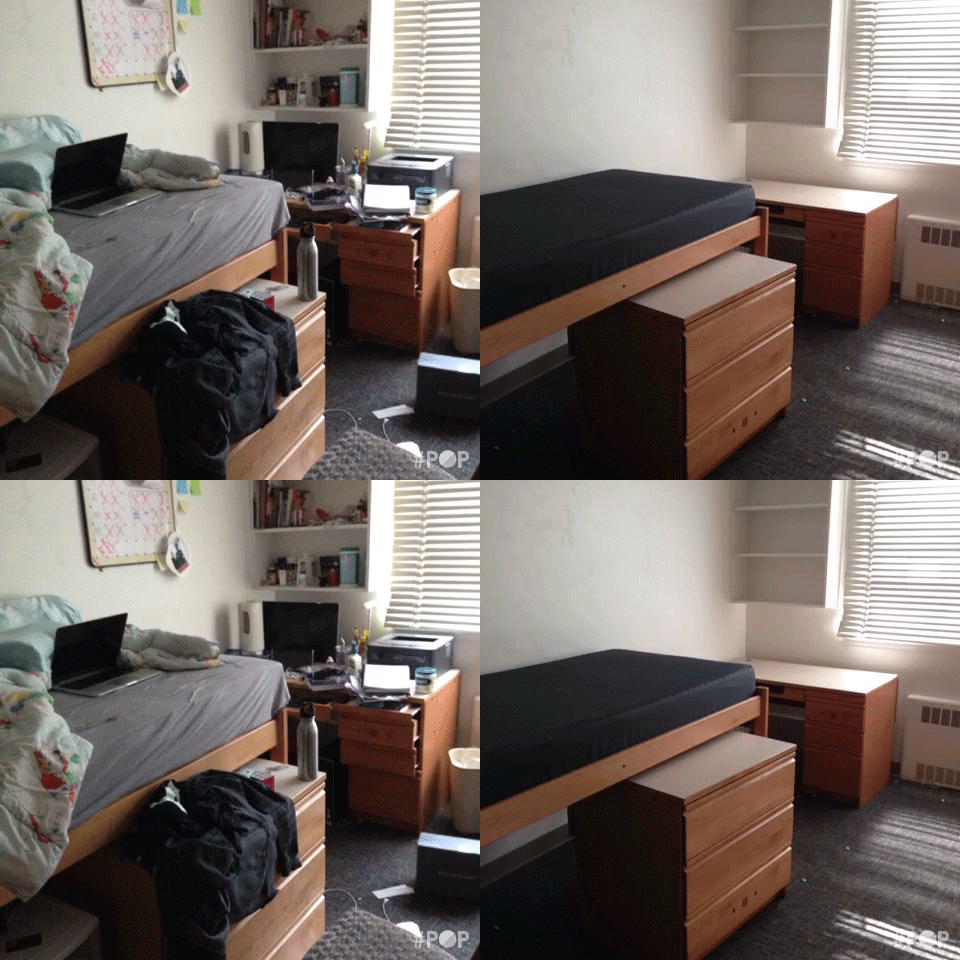
The overriding idea is this: Think of a dorm as a home for tiny little miniature gnomes where everything is 1/4 scale. The keyword is 'Tiny.' A typical dorm has just enough room for the twin size extra long 'beds' it has, the tiny desks and perhaps a tiny bookshelf for each person, and there will be a tiny closet. Space for anything you bring in is really limited.


-Doing laundry during college is not going to be a priority. That doesn't mean bring more clothes. Trust me.
-You'd be surprised how little you actually need in terms of clothing:
  • 4 pairs of pants or jeans
  • 4 shirts
  • 2 hooded sweatshirts
  • 2 or 3 pair of shoes (yes, that seems minimalistic to some)
  • 7 pair socks, 7 underwear
  • 2 pair pajamas or what passes for pajamas
  • jackets, one that's really warm for winter
  • winter scarf or hat, mittens or gloves

So much for clothing.

Here are items actually found in a dorm checklist from a well known store. Revised title:
Completely Pointless Items Nobody Ever Uses in College:
  • Iron and ironing board (you will use these never....and this carries on into adult life)
  • Vacuum (you must be kidding)
  • Your own shower curtain (the great majority of dorm showers are multi-stall and not private)
  • Set of dishes ...skip these, or buy four plates and four bowls from Goodwill or a garage sale. All you really need. Ditto silverware.
  • Sewing kit: Would you actually use it? I thought not.
  • A lap desk?? Really?
  • A jewelry organizer... for what?
  • Bed skirt  (that's actually pretty funny)
                                                              Whatever it is, where would you put it?
  • Several sets of sheets .... Nope, you need one set, maybe two. See laundry habits above.
  • Storage trunk. And this would go where?
  • Shoe storage racks. Everyone knows that shoes are thrown on the floor of the closet.
  • Scale.Seriously?
  • Lounge seating. Where is this lounge exactly??
  • Clothing steamer
  • Coffee maker
  • Dining table (they actually suggested that)
  • Garment Bags


  • Skirt hangers (unless you wear skirts all the time, I suppose)
  • Closet organizer (ha!)
  • Gym bag
  • Socks to wear with rain boots
  • An upgraded shower head, if your school allows it
  • Self Tanning lotion, as well as eye cream, foundation, and concealer
  • Formal clutch (that's a purse you use with a formal dress)
  • Formal dress
  • Little black dress
  • Going out purse (??)
  • Sleep mask
  • Tool kit


Remember, you're sharing the tiny dorm with someone else. Be considerate of your roommate, too.
 
And the most egregious idea ever invented and foisted upon college freshmen and their parents:
(drum roll)                                    ****A futon****


Do not, let me repeat, do not purchase a futon for a dorm room
  • There's not enough room in the dorm
  • They're not fun to carry and wrangle and maneuver into a dorm room
  • They're always bigger than you think they are
  • They're awful to sleep on even if you could get it into the room
  • There's already two or more 'beds' in the room, there is no room for a futon
  • Did I mention there's no room?
  •  Your parent(s) will try valiantly to deliver said futon, and when they've gotten up all 12 floors and realize it won't work, they'll have to bring it back down again. This will not make them happy.
  • On a hot August or early September day, the last thing you want to deal with is moving a futon. Trust me.
  • Yes, you're probably 'lofting' the beds in your dorm. No, that doesn't mean there's room for a futon underneath. A couple of lawn chairs and a cardboard box for a table, yes.

If you want more great examples of what not to bring, simply visit a college campus in the dorm area either at the end of spring or the beginning of fall semester and take a look at the sidewalks and dumpsters: You'll see an abundance of furniture left behind, some of it perfectly good. Those are all things people didn't want or wouldn't fit anywhere, but they didn't care to take back home. You may be able to furnish your first apartment this way....but not a dorm.


Here are some things that actually are helpful:


A Fan.  The great majority of dorms are not air conditioned, and the end of August/beginning of September is hot.


 That's all I can think of. Bring a fan.